

Artificial Intelligence in Industry: 5 Processes Transformed by Autonomous Systems

The Most Important Facts in Brief:
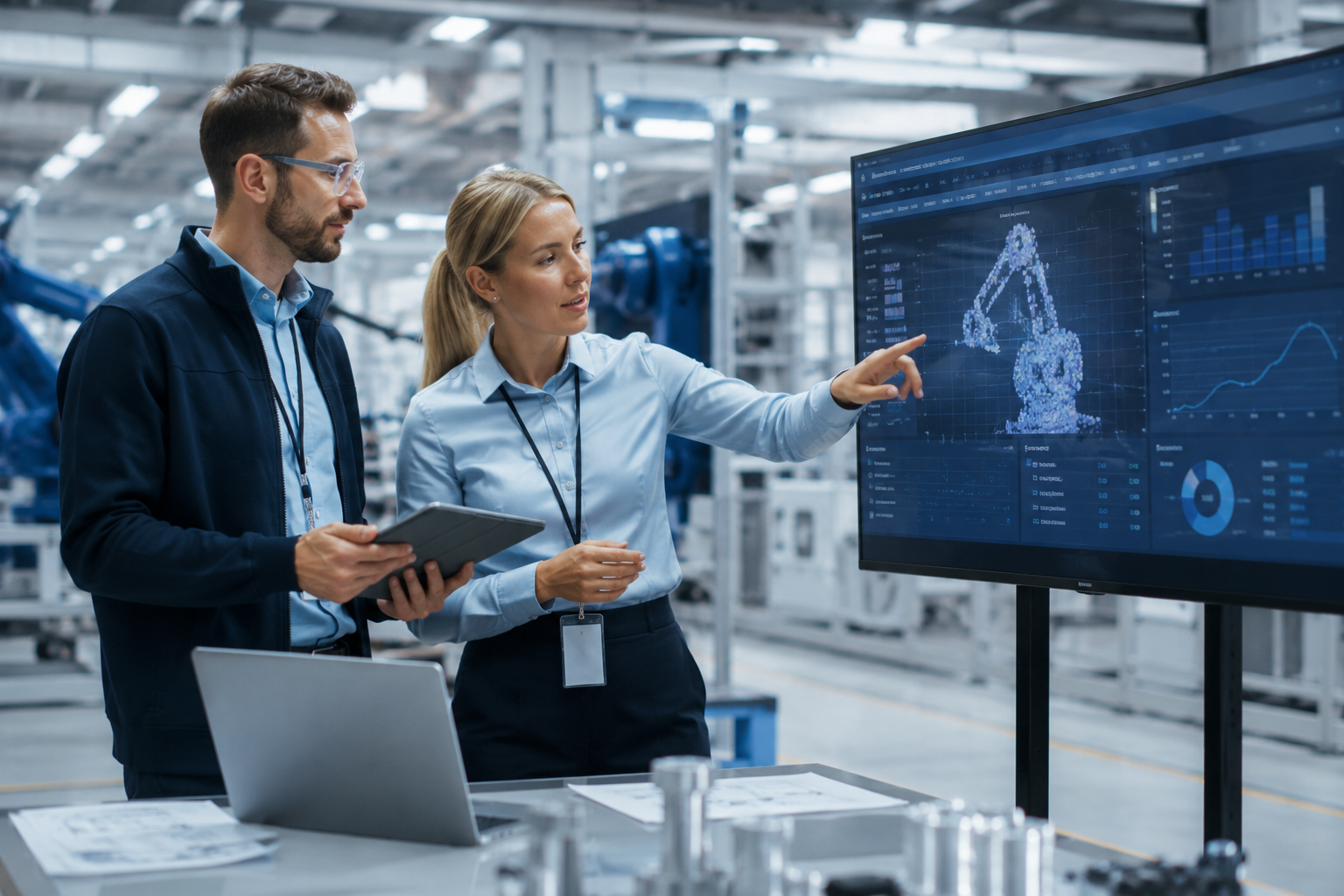
Artificial Intelligence in industry is currently making the decisive leap from pure data analysis to active, autonomous process control. While classic AI applications have previously served primarily as reactive assistance systems, intelligent, autonomous agents (Agentic AI) are now increasingly taking the helm in production and supply chain management. However, this far-reaching AI integration into business processes by no means makes humans obsolete. On the contrary: it elevates the workforce's role to a new strategic level. In this article, we highlight five concrete processes in which artificial intelligence and smart machines are sustainably transforming industry. In addition, we show why professionals who possess both deep industry know-how and methodological AI expertise are today becoming an absolute competitive advantage for modern industrial companies in Germany and worldwide.
The Leap to Autonomy: What Agentic AI Means for Industry
The term Industry 4.0 has shaped the strategic direction of manufacturing companies for over a decade. Until now, the focus has been on the digitalization of production processes, the networking of plants, and the collection of gigantic amounts of data (Big Data). But the mere existence of data does not generate value. The true significance of current technological development lies in the way this information is used. This is where Artificial Intelligence marks the decisive turning point.
So far, the use of AI in many factories has focused on pure pattern recognition. Machine learning models analyzed historical data to highlight deviations in production processes or predict the wear and tear of components. The resulting actions – such as stopping a machine or reordering material – still remained the responsibility of humans.
With the emergence of Agentic AI, this dynamic is changing fundamentally. We are talking here about AI systems that are equipped with genuine autonomy of action. Such an AI agent not only analyzes the situation but independently derives the optimal course of action, uses connected software interfaces, and actively intervenes in production. In international research and science, this path is seen as the most important key to the true Smart Factory. When robots and machines no longer just process rigidly programmed processes, but react dynamically to disruptions in supply chains or fluctuations in product quality, unprecedented efficiency gains arise.
For the economy, and especially for medium-sized enterprises, the use of such AI solutions opens up enormous potential. The focus is no longer on the simple automation of repetitive tasks, but rather on the proactive control of highly complex systems. The performance of autonomous agents is becoming the foundation for securing global competitiveness. But to translate these advantages and opportunities into tangible business results, a clear information and data strategy as well as sound AI methodology are required. Blindly buying new technology is not enough – the success of modern industry is decided by the collaboration between autonomous intelligence and human creative power.
5 Processes in Transition: Where AI Systems Make the Difference Today
When we look at the use of AI in practice, it becomes apparent that intelligent technologies have long outgrown research laboratories. They are penetrating the real business processes of industrial companies and completely redefining the way products are manufactured. The integration of autonomous AI solutions into existing architectures creates tangible benefits. The following five areas of application illustrate how extensively Agentic AI is transforming industry.
1. Predictive Maintenance: Autonomous Upkeep & Asset Management
Predictive maintenance is a classic example of the successful use of Big Data in manufacturing. But Agentic AI takes this concept a crucial step further. Previously, an artificial intelligence merely reported: "Machine B is expected to fail in 48 hours." An autonomous agent, on the other hand, immediately plans the necessary maintenance based on this information. It independently cross-references the shift schedule of the maintenance specialists, orders the required spare part in the ERP system, and temporarily reschedules the production processes so that no critical bottleneck occurs in the overall plant.
2. Supply Chain Orchestration: Real-Time Adaptation of Supply Chains
Global supply chain management is highly vulnerable to unforeseen disruptions – be it due to weather events, geopolitical tensions, or local outages. Traditional processes require enormous manual intervention here. Autonomous AI systems act as intelligent orchestrators within the supply chains. If a supplier reports a delay, the agent scans the global market in real-time for alternative suppliers, evaluates quality and freight costs, autonomously triggers the order, and dynamically adjusts the delivery dates for the end customer. This speed of reaction secures a massive competitive advantage.
3. Production Processes: Dynamic Planning Instead of Rigid Cycles
In traditional factories, production processes follow rigid, predefined routes. If a robot fails or an urgent major order comes in, there is a threat of standstill. Agentic AI enables fully dynamic production planning. The system views the shop floor as a flexible network. Autonomous AI methods calculate the optimal path for workpieces through the production cells every second and assign tasks to machines and Automated Guided Vehicles (AGVs) in real time. This fluid process optimization leads to unprecedented efficiency gains and maximizes the productivity of the entire facility.
4. Product Quality: AI-Based Visual Inspection & Error Correction
For a long time, ensuring product quality was based on random, human checks. Thanks to the use of computer vision and deep machine learning, 100 percent of components are now checked for micro-cracks or dimensional deviations in milliseconds. The agentic aspect: if the system detects an emerging accumulation of minimal deviations, it does not just sort out the defective parts. The agent communicates directly with the upstream milling machine and autonomously adjusts its parameters (such as cutting speed or pressure) before actual scrap is produced.
5. Energy Management: Increasing Efficiency in the Smart Factory
In view of rising energy costs and stricter political sustainability requirements, energy management is moving into the focus of the C-level. Autonomous AI agents act as highly intelligent control units here. They analyze power market data in real-time, forecast the energy requirements of their own production, and autonomously switch on energy-intensive processes exactly when electricity from renewable energies is cheap and abundantly available. This intelligent support not only saves the budget but also massively improves the companies' ecological footprint.
Why Agentic AI Does Not Replace Professionals, But Frees Them
The introduction of highly autonomous systems often fuels concerns in public debate about massive job losses. Especially in Germany, a country with a strong industrial tradition, Artificial Intelligence in industry is sometimes perceived as a threat to everyday working life. But practice and leading AI researchers paint a completely different picture: Agentic AI does not make humans obsolete; it frees them from repetitive, data-intensive routines.
The use of intelligent agents does not mean the end of human labor, but its strategic upgrade. The role of employees is changing fundamentally – from the mere "operator" of a machine to the "orchestrator" of complex systems. When artificial intelligence takes over the hourly monitoring of sensor data and autonomous error correction, specialists and executives regain valuable capacities. This newly gained time is essential to focus on the true challenges of the modern economy: creative problem-solving, strategic planning, and the development of entirely new, data-driven business models.
The Symbiosis of Human and Artificial Intelligence
The highest productivity in modern factories does not arise where machines completely displace humans, but where seamless collaboration takes place. Autonomous AI systems are unbeatable at processing terabytes of data in real-time and drawing logical conclusions within their defined framework. What they lack, however, is contextual knowledge, emotional intelligence, ethical judgment, and the ability to manage completely unstructured, cross-industry crises.
It is precisely at this intersection that human intelligence becomes indispensable. The professionals of the future will set the strategic goals, define the guardrails for the autonomous agents, and intervene correctively when the algorithms reach their limits. This shift in activities not only positively impacts companies' efficiency gains but also improves the lives and satisfaction of the workforce, as monotonous, physically and mentally demanding tasks are outsourced to technology.
However, to complete this transition successfully, a clear strategic direction from top management is required:
Central Levers of Adaptation in the AI Era

To successfully master the integration of Agentic AI, manufacturing companies must focus on three central points: the consistent modernization of their data architecture, the strategic education of the workforce to reduce reservations, and the targeted further development of their specialists and executives. Only those who holistically manage these technological and human factors will secure their own future viability.
The New Profile: The Bridge Builders Between Industry and Intelligence
When autonomous AI systems take over the control of complex production processes, the demand for talent inevitably changes as well. The greatest challenge for companies currently is not a lack of pure technology, but a glaring shortage of qualified professionals who can integrate these autonomous architectures into Industry 4.0 in a value-adding way.
Practice clearly shows: an excellent data scientist without a deep understanding of mechanical manufacturing processes will fail on the factory floor just as much as a brilliant mechanical engineer who cannot penetrate the algorithmic logic of neural networks. The economy today is desperately seeking "bridge builders" – interdisciplinary experts who fluently master both worlds.
Recruiting in Highly Complex Key Industries
To identify these rare profiles, companies must adapt their HR strategies on an industry-specific basis. Those who want to find the best talent for complex transformations in the field of Industry 4.0 and mechanical engineering need leaders who bring a holistic understanding of hardware and software.
The exact requirements vary enormously depending on the sector: in the automotive sector, it is about connected vehicle fleets and smart production lines, while in the energy industry, the focus is on the intelligent control of power grids through AI. Ultimately, in all these industries, the goal is to specifically recruit specialists for the management of AI, IoT, and automation systems who not only program but understand networked production lines as holistic IT ecosystems.
From Middle Management to Strategic Orchestrator
This technological shift has serious implications for traditional hierarchies. The role of leaders changes dramatically when Artificial Intelligence no longer just assists but acts autonomously. A look at AI in the working world shows: generative AI vs. middle management in Industry 4.0 is no longer a theoretical concept but lived practice. Middle management must bid farewell to the pure monitoring function and instead take on the strategic orchestration of the agents.
Cultural Change Through Upskilling and Mentoring
Since the market for ready-made AI engineers with deep industry know-how is virtually swept clean, the development of one's own workforce is gaining enormous urgency. Strategic upskilling is essential to relieve existing employees of their fears of contact with autonomous machines and equip them with the necessary tools for data analysis. Establishing an open corporate culture in which lifelong learning and mentoring are firmly anchored as key qualifications in Industry 4.0 is becoming the ultimate competitive advantage in the battle for technological leadership among industrial companies.
Are You Looking for the Architects of Your Industry 4.0?
Find outstanding tech and engineering executives with Benomik who will digitize your production and make it future-proof with AI technologies. Benefit from our specialized executive search network.
Schedule a Recruiting Consultation NowAI Integration as the Key to Global Competitiveness
The advent of autonomous agents marks a historic turning point. Artificial Intelligence in industry is no longer just a passive analytical tool in the hands of human analysts, but is becoming an active, controlling element within highly complex production processes. Agentic AI breaks through the boundaries of traditional automation and orchestrates supply chains, maintenance, and quality control in real time.
But the most modern technology and the deepest algorithmic models go to waste if the human component is neglected. The shift towards true Industry 4.0 requires a radical rethink at the C-level. Companies that want to secure their competitiveness on the global market must act now. It is not only necessary to invest in intelligent systems but simultaneously to prepare the workforce for their new roles as orchestrators through strategic upskilling.
Even more crucial, however, is the timely recruitment of those rare professionals and leaders who act as interdisciplinary bridge builders between classic mechanical engineering and cutting-edge AI methodology. Successful AI integration is ultimately not a pure IT project, but a strategic realignment of the entire company. Those who master this technological and personnel development today are laying the foundation for the sustainable and profitable factory of tomorrow.
What challenges are you currently facing?
Take our quick surveyOther Insights




.png)


